
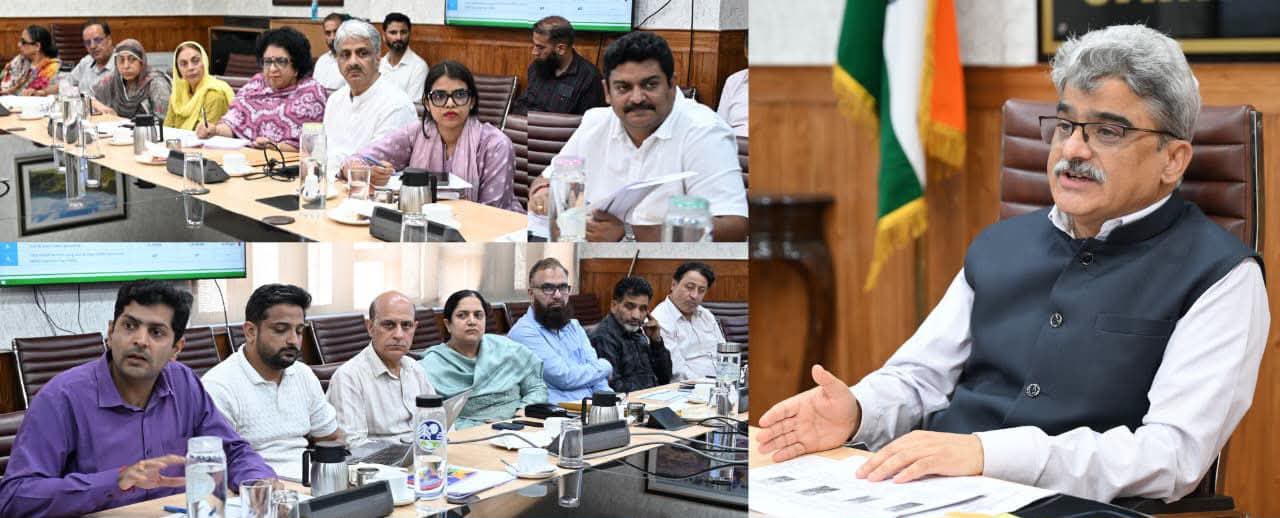
Srinagar, Jul 27: Chief Secretary Atal Dulloo on Monday chaired a high-level review meeting to assess the implementation of the Ayushman Bharat Digital Mission (ABDM) across Jammu and Kashmir, directing the Health Department to accelerate the creation of comprehensive digital health records for every citizen and strengthen the Union Territory’s digital healthcare ecosystem.
The meeting focused on the progress achieved under the Mission, adoption of digital health solutions, implementation of the Hospital Management Information System (HMIS), and expansion of citizen-centric healthcare services across Jammu and Kashmir.
Senior officials, including Commissioner Secretary, Health and Medical Education Department, Mission Director, National Health Mission, Managing Director, ABDM J&K, Principals of Government Medical Colleges Srinagar and Jammu, Director Health Services Jammu, and other senior officers attended the meeting.
Addressing the officers, the Chief Secretary said that while Jammu and Kashmir has made significant progress in generating Ayushman Bharat Health Account (ABHA) IDs and strengthening digital health infrastructure, the ultimate objective of the Mission remains the creation of complete, secure and interoperable digital health records for every citizen.
He directed the Mission authorities to formulate a well-defined implementation strategy with clear milestones for increasing the generation and linkage of electronic health records across the Union Territory.
Dulloo further instructed the department to expedite implementation of the Hospital Management Information System (HMIS) across all healthcare institutions, particularly government health facilities, so that every patient interaction contributes towards building comprehensive digital health records.
The Chief Secretary also directed officials to ensure that the number of ABHA IDs created is progressively brought at par with the number of Ayushman Bharat Golden Cards issued in Jammu and Kashmir by fixing measurable targets and monitoring them regularly to achieve universal digital health coverage.
Emphasising improved public access to healthcare services, Dulloo called for maximum utilisation of the JK Sehat App, urging the department to promote home healthcare services, online doctor appointments, tele-consultation facilities and doorstep delivery of medicines through local pharmacies. He observed that these digital services have immense potential to improve accessibility, convenience and the overall quality of healthcare delivery.
Describing the JK Sehat App as a comprehensive digital healthcare platform, the Chief Secretary directed the department to further strengthen the application by incorporating additional academic resources, digital library content and medical courses for undergraduate and postgraduate students, transforming it into a robust healthcare as well as knowledge-sharing platform.
He also instructed the department to identify and resolve operational bottlenecks affecting digital health initiatives in coordination with healthcare institutions, technical agencies and implementing partners to ensure timely achievement of Mission objectives.
During the meeting, Commissioner Secretary, Health and Medical Education Department, M. Raju informed that Jammu and Kashmir has emerged as one of the country’s leading performers under the Ayushman Bharat Digital Mission.
He said the Union Territory was recently conferred the National Award by the National Health Authority for achieving the highest health record linking per lakh population among medium-sized States and Union Territories. Earlier this year, J&K was also recognised for having the best-performing model healthcare facilities under the Mission.
Managing Director, ABDM J&K, Ananth Dwivedi informed the meeting that more than 1.12 crore ABHA IDs have been generated across Jammu and Kashmir, covering nearly 83 per cent of the estimated population. He added that the number of ABHA-linked electronic health records has increased significantly, while over 1.34 crore Scan & Share tokens have been generated, indicating growing public adoption of digital healthcare services
The meeting was also informed that 100 per cent registration of public healthcare facilities, doctors and nurses has been completed on the Health Facility Registry (HFR) and Health Professional Registry (HPR), ensuring complete integration of the public healthcare system with the national digital health platform.
Officials further informed that key action points identified during the previous review, including universal registration of public doctors, generation of unique health records and integration of radiology and imaging reports with ABHA IDs, have been successfully achieved.
Reviewing district-wise progress, the Chief Secretary directed Deputy Commissioners, Chief Medical Officers and district health authorities to intensify awareness and registration campaigns in districts requiring improvement to achieve universal ABHA coverage within the stipulated timeframe.
He emphasised that every eligible citizen visiting a healthcare institution should be facilitated in creating an ABHA ID at the point of service while sustained awareness drives and inter-departmental coordination should continue across the Union Territory.
The Chief Secretary also reviewed implementation of the JK e-Sahaj platform and the transition to the Next Generation e-Hospital Solution. Officials informed that JK e-Sahaj has already been implemented in more than 100 healthcare facilities, while 85 hospitals have been onboarded onto the Next Generation HMIS platform. The remaining identified institutions are expected to be integrated within the next two weeks, followed by phased implementation of registration, IPD, pharmacy, laboratory and radiology modules.
The meeting also reviewed progress on Scan & Share, Electronic Medical Record (EMR) generation and digital health record linkage across healthcare institutions. Officials informed that a majority of patients visiting government hospitals are now using digital registration through the Scan & Share facility, while efforts are underway to further strengthen linkage of laboratory, pharmacy and radiology reports with ABHA IDs.
The meeting was informed that the JK Sehat App has registered over 15.5 lakh citizens, with lakhs of users availing various digital healthcare services, including ABHA creation, health record access, blood bank services, online appointments, tele-consultation, ambulance services, home healthcare and pharmacy services. The latest version of the application also includes a Health Locker and enhanced digital health features for greater citizen convenience.
While reviewing the future roadmap, the Chief Secretary directed the department to achieve 100 per cent ABHA saturation, strengthen generation of ABHA-linked electronic health records, maximise utilisation of Scan & Share services in hospitals and expand ABDM-enabled HMIS implementation across all healthcare institutions in Jammu and Kashmir to ensure universal digital healthcare coverage. (KNC)