
New Delhi, August 15: Prime Minister Narendra Modi on Saturday called upon the people of India to dream big, work collectively and contribute towards building a developed and self-reliant nation by 2047, as he addressed the nation from the historic Red Fort on the occasion of the country’s 80th Independence Day.
Delivering his 13th consecutive Independence Day address from the Red Fort, Prime Minister Modi paid rich tributes to Mahatma Gandhi and the freedom fighters whose sacrifices paved the way for India’s independence.
Emphasising the country’s long-term national vision, Modi said that India could no longer afford to set small ambitions and must aspire to achieve the goal of ‘Viksit Bharat’ by 2047.
“Small dreams are not sufficient anymore. We should dream big. India has a big dream to become ‘Viksit Bharat’ by 2047. When the world’s most populous nation resolves to become developed, the world will look at us differently,” the Prime Minister said.
He said India’s aspirations must correspond with its enormous potential and urged citizens to work together to build a stronger, developed, self-reliant and prosperous India.
The Prime Minister also highlighted the significance of ‘Vande Mataram’ echoing from the ramparts of the Red Fort, describing it as an important and inspiring feature of the national celebrations.
PM Modi’s Traditional Red Tie-and-Dye Turban Draws Attention
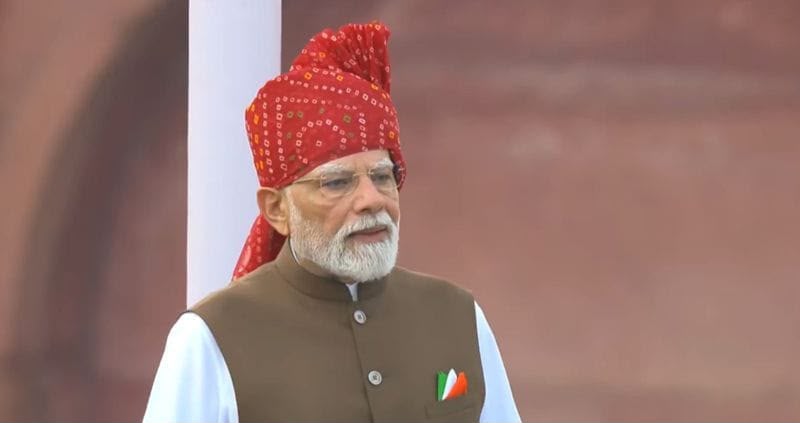
Prime Minister Narendra Modi also drew considerable attention for his traditional Independence Day attire, appearing at the Red Fort wearing a red tie-and-dye turban, continuing his tradition of showcasing India’s rich cultural heritage through traditional headgear.
He paired the red turban with a white kurta and chocolate-brown vest, while three pocket squares in saffron, white and green added a subtle Tricolour touch to his appearance.
The traditional tie-and-dye turban is closely associated with the cultural traditions of Rajasthan and Gujarat. Over the years, Modi’s distinctive Independence Day turbans have become a prominent visual feature of the national celebrations.
Last year, the Prime Minister wore a vibrant Rajasthani leheriya turban featuring orange, yellow and green shades, highlighting India’s diverse textile traditions.
In 2023, he opted for a bandhani-print turban in yellow, green and red, paired with a black V-neck jacket. In 2022, he wore a saffron turban decorated with red motifs and featuring a flowing tail, along with a blue jacket and stole.
His 2021 Independence Day attire featured a cream-and-saffron turban, while in 2020, during the COVID-19 pandemic, he wore a white scarf with a saffron border that also served as a protective face covering.
Prime Minister Modi’s first Independence Day appearance as Prime Minister in 2014 featured a striking red Jodhpuri bandhej turban. He continued the tradition in subsequent years with colourful and regionally inspired turbans.
In 2015, he wore a yellow and multicoloured crisscross-patterned turban, followed by a pink-and-yellow tie-and-dye turban in 2016 and a red-and-yellow turban in 2017.
In 2018, saffron emerged as the dominant colour of his Independence Day turban.
The Prime Minister’s evolving choice of traditional turbans has now become an annual feature of his Independence Day appearances, reflecting India’s regional craftsmanship, textile traditions and cultural diversity.
Focus on Viksit Bharat by 2047
The central theme of Prime Minister Modi’s Independence Day address remained India’s ambition to become a developed nation by 2047, when the country will mark 100 years of independence.
Calling for collective national effort, Modi urged citizens to look beyond limited ambitions and contribute towards strengthening the country’s economy, self-reliance, infrastructure, innovation and overall development.
The Prime Minister’s message from the Red Fort underlined the government’s continued emphasis on ‘Viksit Bharat’, with the vision of transforming India into a developed, prosperous and globally influential nation by 2047.(KNC)