

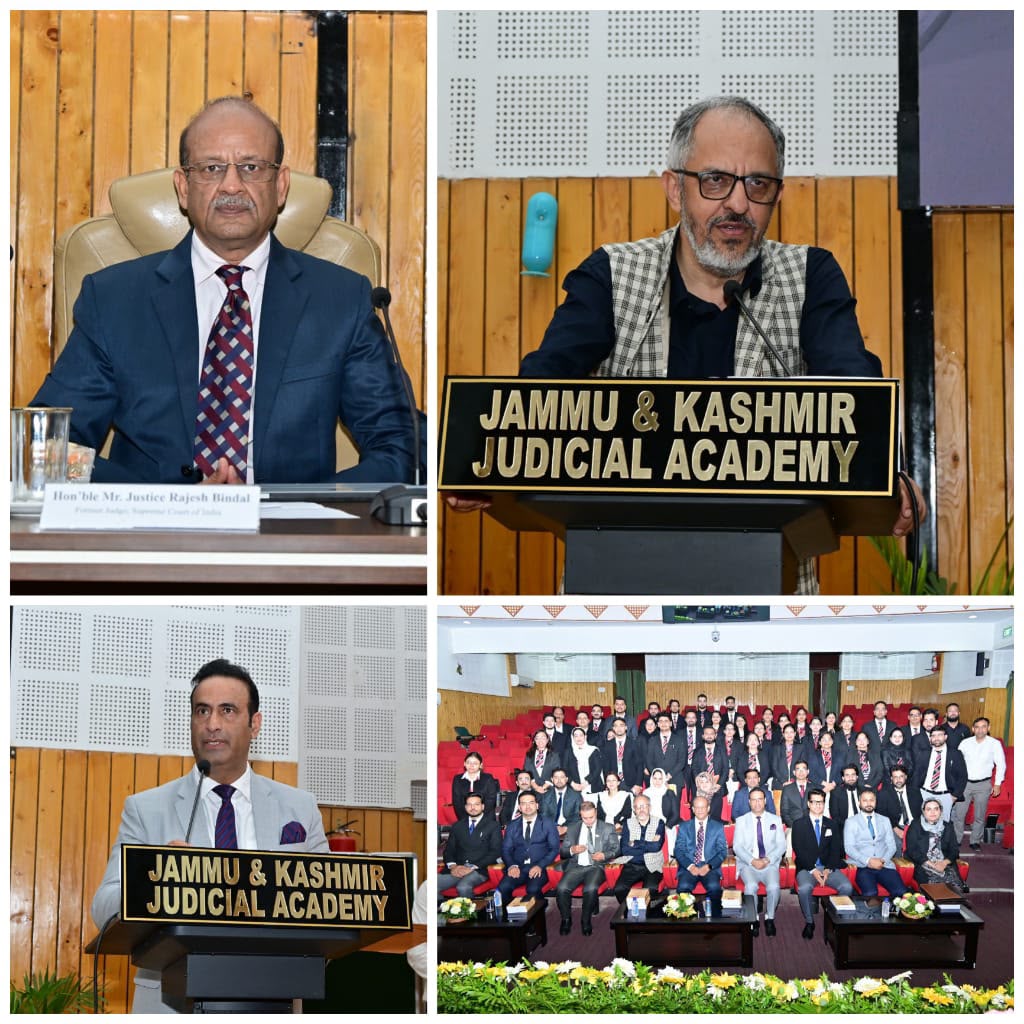
Srinagar, July 18: The Jammu & Kashmir Judicial Academy on Saturday organised Day-33 of the Pre-Appointment Induction Training Programme for Trainee Civil Judges (Junior Division), Batch-2026, along with a Continuing Judicial Education Programme for Judicial Officers of Batch-2020 at its Mominabad campus in Srinagar.
The programme was conducted under the patronage of Hon’ble Mr. Justice Sanjeev Kumar, Acting Chief Justice of the High Court of Jammu & Kashmir and Ladakh, and under the guidance of Hon’ble Mr. Justice Rajnesh Oswal, Chairman of the Governing Committee of the J&K Judicial Academy.
During the morning academic sessions, Hon’ble Mr. Justice Rajesh Bindal, Former Judge of the Supreme Court of India, delivered comprehensive lectures on “Technology in the Administration of Justice” and “Artificial Intelligence for Judges.” He highlighted the transformative role of technology in ensuring an efficient, transparent and accessible justice delivery system, while emphasising the judiciary’s ongoing transition towards digital and paperless courts.
Justice Bindal demonstrated the use of key digital platforms, including the National Judicial Data Grid (NJDG), Electronic Supreme Court Reports (eSCR), and the Bhashini application, explaining their significance in legal research, judicial functioning and improving access to justice.
Speaking on Artificial Intelligence, Justice Bindal observed that AI can substantially assist judges in legal research, drafting, summarisation and transcription. However, he firmly stressed that AI can never replace the independent judicial mind, urging judicial officers to use technology responsibly while ensuring that the ultimate responsibility for judicial decisions always rests with the judge.
The afternoon sessions were conducted by Hon’ble Mr. Justice Rahul Bharti, Judge of the High Court of Jammu & Kashmir and Ladakh and Member of the Governing Committee of the J&K Judicial Academy.
Addressing both serving judicial officers and trainee civil judges, Justice Bharti underscored that the judicial profession requires continuous learning, intellectual discipline and unwavering commitment to judicial responsibilities. He encouraged participants to cultivate the habit of regularly studying law, jurisprudence, legal history and evolving judicial precedents.
Justice Bharti observed that every case demands careful application of mind and stressed the importance of clarity, analytical reasoning and precision in judgment writing. He also called upon judicial officers to uphold the highest standards of professionalism, diligence, humility and accountability throughout their judicial careers.
Earlier, Mr. Naseer Ahmad Dar, Director, J&K Judicial Academy, welcomed the distinguished resource persons, judicial officers and trainee civil judges. He highlighted the importance of the programme in strengthening judicial competence through discussions on technology, artificial intelligence, judgment writing, decrees and judicial orders.
The programme concluded with an interactive session, during which participants actively engaged with the resource persons on contemporary challenges in judicial administration, technological advancements and judicial decision-making. The discussions provided valuable insights and further enriched the professional learning experience of both serving judicial officers and newly inducted Civil Judges (Junior Division). (KNC)