
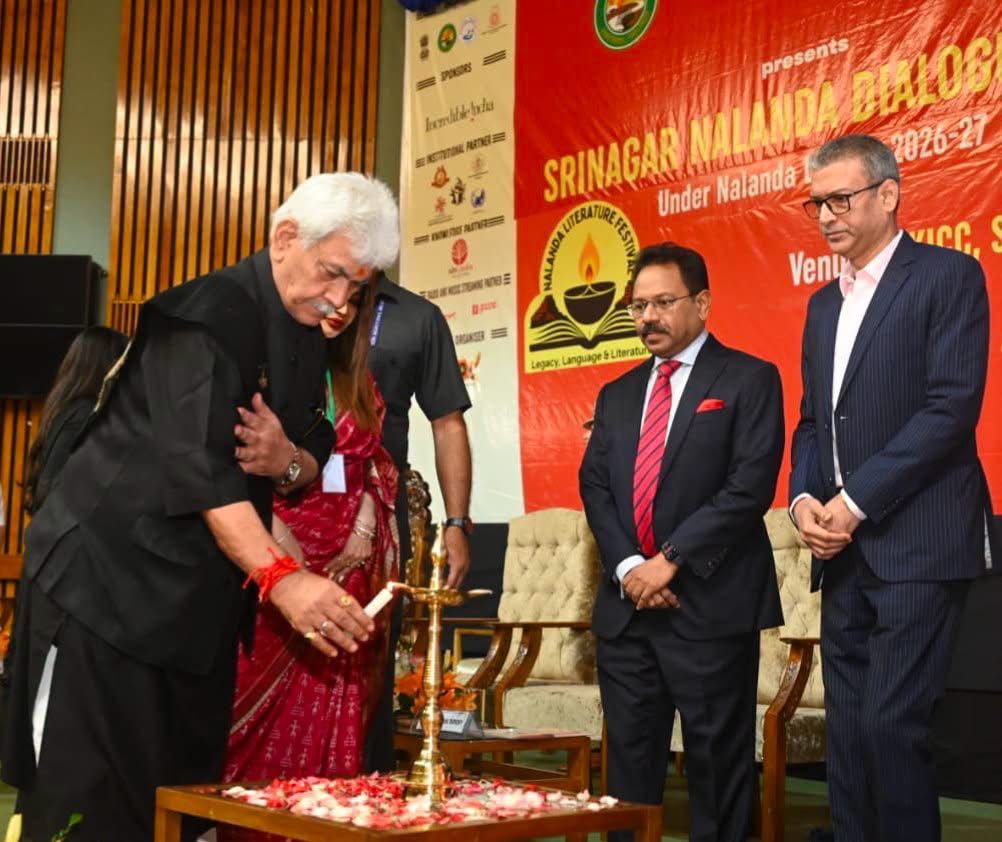
Srinagar, June 20: Lieutenant Governor Manoj Sinha on Saturday said that the Srinagar–Nalanda Dialogue serves as a significant platform to revive India’s rich traditions of knowledge and spirituality while building a future-oriented education system that connects the younger generation with both the country’s civilizational heritage and modern technological advancements.
Addressing the Srinagar–Nalanda Dialogue, the Lieutenant Governor emphasized the need to strengthen India’s enduring civilizational values and intellectual traditions. He said the objective of the dialogue is to reconnect with the nation’s great inheritances of wisdom, learning and spiritual thought, while preparing youth to meet the challenges and opportunities of the modern era.
LG Sinha observed that scholars from Jammu and Kashmir and Nalanda collectively contributed to shaping one of the world’s oldest living civilizations. He noted that the historic intellectual exchanges between Kashmir and Nalanda remain a source of inspiration and continue to illuminate the path toward cultural and educational resurgence.
Highlighting the relevance of India’s ancient centres of learning in contemporary times, the Lieutenant Governor said that the country’s educational framework must draw strength from its historical roots while embracing innovation, research and emerging technologies. He stressed that such an approach would help nurture enlightened, skilled and globally competitive citizens.
“The heritage shared by Jammu and Kashmir and Nalanda is our guiding light. The Srinagar–Nalanda Dialogue provides an opportunity to carry that light forward with wisdom, courage and a renewed vision for Viksit Bharat,” he said.
The Lieutenant Governor further underscored the importance of preserving India’s intellectual and spiritual legacy and integrating it into modern educational practices to ensure holistic development and national progress.
The Srinagar–Nalanda Dialogue brought together scholars, academicians and intellectuals to deliberate on India’s civilizational heritage, educational transformation and the role of knowledge traditions in shaping the future of the nation.(KNC)